

Freckles/age spots/skin blemishes
Pico toning? Stop the treatment that was wrong from the beginning.


This is a photo taken with the consent of a client who actually received treatment at Ulsan Snow Clinic, captured under the same conditions without any retouching.
All skin procedures may have side effects such as inflammation, pigmentation, and redness.
Hello.
This is Ulsan Snow Clinic.
“I have received Pico Tonning more than 10 times.
But there really has been no change at all.”
Every time I hear this,
There is something I need to check first.
What equipment was used,
What approach was taken...
Then we can find the cause.
Although they are called the same procedure, in reality, most people receive completely different treatments.
Even if you look at the same menu called 'melasma toning',
in some places, you see significant changes after 3 sessions,
while in others, even after 15 sessions, there is no progress.
Today, I will reveal those 'invisible differences'.
1. Even if the equipment is the same, if the method of use is different, the results will also be different.
"If it's a PicoSure or Potenza, they should all be similar, right?"
This is the biggest misconception.

Even if the same pico laser is used
how much output was given
how deep the penetration is in mm
What tips were used, and in what mode?
Was it for melasma, pores, or what specific issue?
Each of these variables changes
the skin's response completely.

"Are the settings really that important?"
Let me give you one example.
In cases where epidermal melasma and dermal melasma are mixed,
the approach regarding which wavelength to use first,
whether to gradually increase the output or to start strong
becomes the criterion that distinguishes between 'not much has changed' and 'definitely brightened'.
The reason for investing over 1 billion won in equipment after opening is
not simply to have a lot of equipment,
to create possibilities for combinations when one method does not suffice,
and to tailor treatments specifically for each individual's skin.
This is to achieve optimal results.
2. If the procedure is done without a diagnosis, the direction may be wrong from the start.
“The melasma has become darker.”
“My skin has actually become more sensitive than before.”
When performing pigment treatments
I often encounter individuals whose condition has worsened due to laser treatments done without an accurate diagnosis.

Why does this happen?
It is because they started without a proper diagnosis
using the formula 'melasma = toning' indiscriminately.
This is especially true for pigment treatments.
Is your skin sensitive to heat?
Is the barrier compromised?
How did your skin react to previous treatments?
Are there any history of redness or inflammation?
If these factors are not considered,
the reaction can vary drastically even with just one output intensity.
Therefore, at Snow Clinic, we always
use the Mark-Vu diagnostic device to quantify and assess the skin condition before any procedure.

Pigment distribution and depth, presence of inflammation,
vascular development, and barrier recovery
First, we secure data that cannot be identified visually
and then decide on the treatment.
This is to make judgments based on evidence, not intuition.
3. Ultimately, even the same procedure is differentiated by 'who performed it'
The same laser, the same equipment, the same number of sessions.
However, if some clinics show results and others do not at all,
the difference ultimately lies in the 'hands'.
That difference is ultimately the 'skill'.
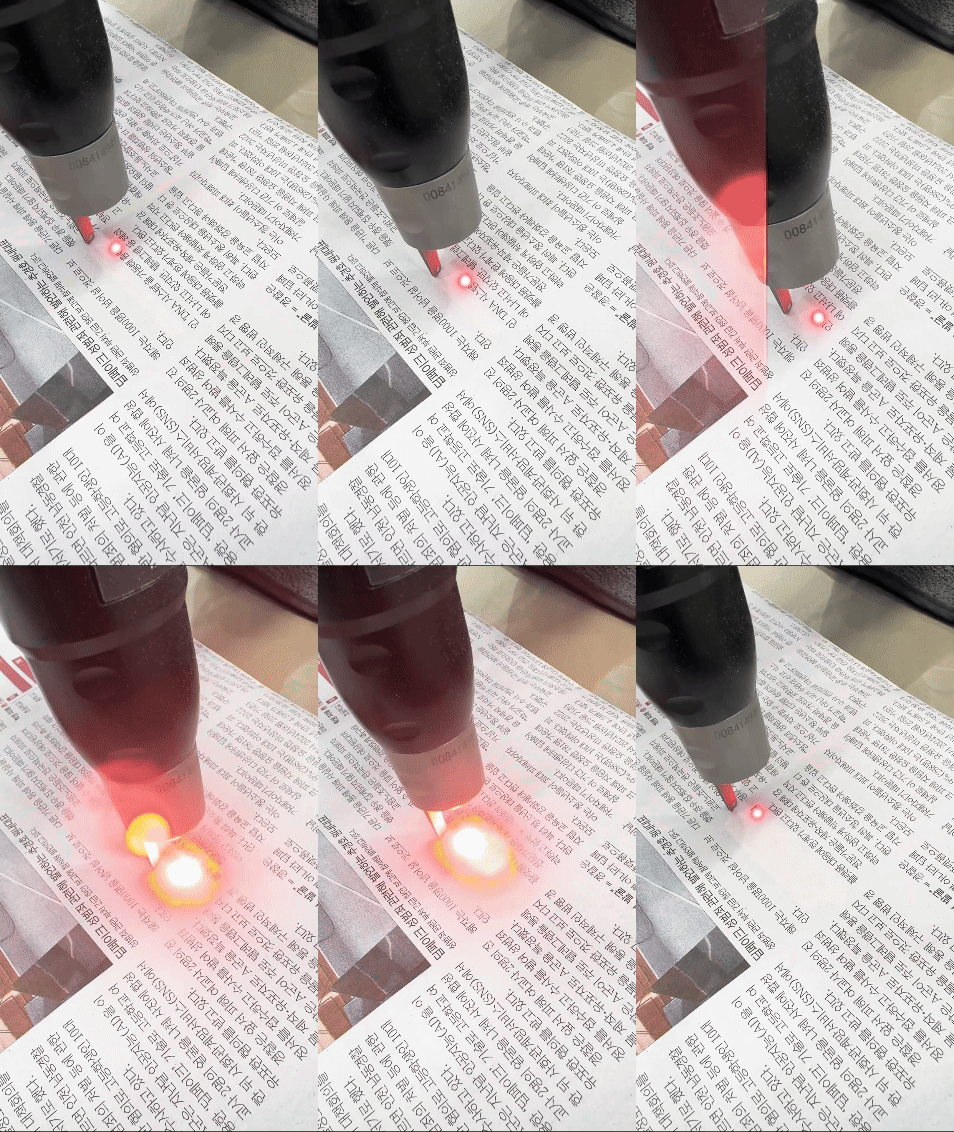
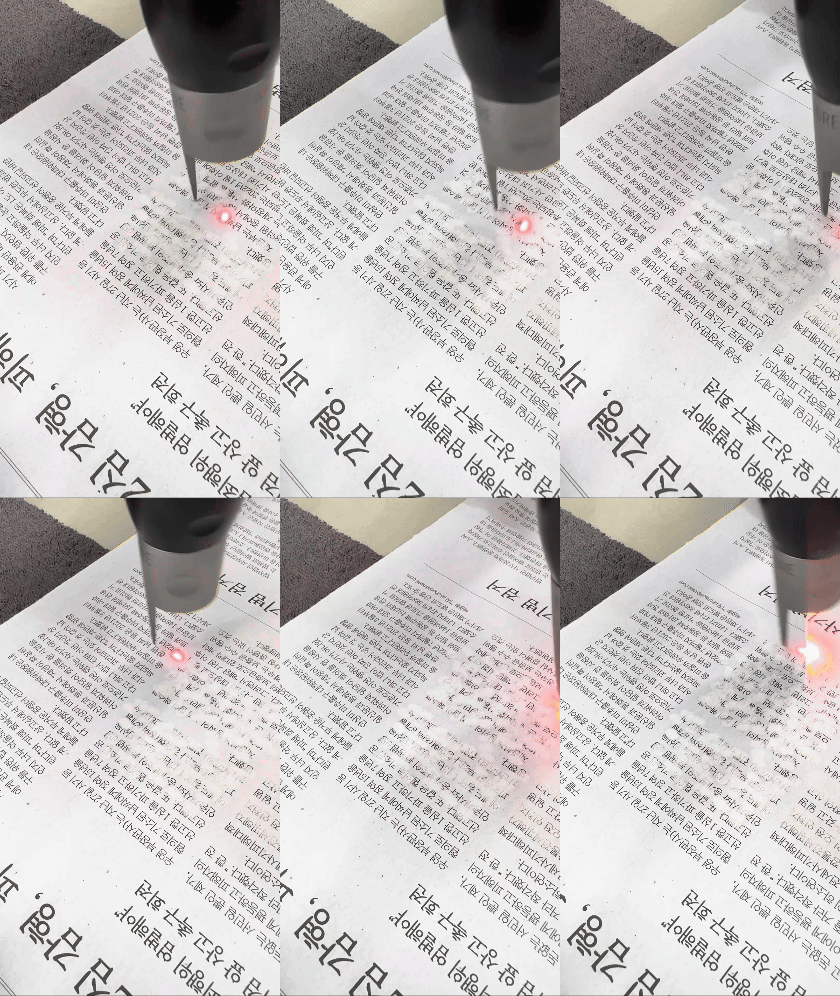
Even just treating melasma
requires decisions on what output to start with,
which area to approach first,
and when to increase or decrease the intensity...
These judgments must be made in real-time.
In mixed melasma,
whether to target the pigment in the dermis
or to address the epidermis first
can result in a treatment duration that differs by more than double.
If approached incorrectly, the pigmentation may become darker
or excessive inflammatory reactions may occur.
This is not something that the equipment can handle on its own.
Ultimately, it is the judgment and experience of the doctor that determines this aspect.
Therefore, I meticulously record
the reactions for each procedure, and adjust the plan for the next session.
I believe that treatment is not a formula, but rather a conversation with the person's skin.
<Conclusion>
Dermatological procedures are not simply
a matter of being at a
‘well-equipped hospital’ and having done it ‘a few times’.
What equipment is used
How precisely that equipment is adjusted
How well the practitioner reads and adjusts to the skin
And before that, was the diagnosis made properly?
It must be a treatment that encompasses all of this.
The phrase 'I received it as is'
can change to 'It has really changed now'.

And I always ask myself before a procedure.
“If it were my family,
could I perform the procedure under these conditions?”
In front of that question,
The hands naturally move more slowly,
the explanations become more detailed,
and even a single procedure is approached with 'a little more' caution.
Ultimately, what matters is not a single glamorous procedure but
the attitude of fully understanding and taking responsibility for a person's skin.
Thank you for reading this long text.
This was Ulsan Snow Clinic.